Overblog Tous les blogs Top blogs Technologie & Science Tous les blogs Technologie & Science
Suivre ce blog Administration + Créer mon blog
MENU

Outsiders and the advancement of science

1 Octobre 2014, 17:05pm

| 

Publié par Fabien Besnard

L'éléphant n°8 will be out tomorrow (more about this later), and it reminds me of a nice discussion with philosopher Karine Prévot about whether outsiders in a field are more likely to make unexpected breakthroughs. This seems to be a widely held belief, but it could easily be a myth kept alive by some spectacular but in fact very uncommon examples.

There are indeed arguments going in either direction. On one hand it seems reasonable that outsiders bring with them some fresh air and a new way of looking at old unsolved problems. On the other hand, why someone lacking a thorough education in a given field would ever come up with interesting ideas ? Spending years working on a subject would be pointless: just wait for an outsider to come and solve the problem. This seems ridiculous.

Still, there are some significant examples. The question is how much significant they are. Surprisingly, I did not find any research paper on this question.

Anyway, below is a little list I have compiled (with the help of many people at mathoverflow, may they be thanked) of famous scientists who made some important contribution in a field other than their own. Feel free to expand it.

From physics to biology:

Erwin Schrödinger: the famous physicist wrote "What is life ?", a book which has been very influential in the biology community, in particular on James Watson.

Francis Crick : speaking about Watson, Crick was primarily educated as a physicist, and only began studying biology in 1947, according to his wikipedia entry.

Max Delbrück was a theoretical physicist who came to be more and more interested in biology. He earned the Nobel prize in physiology and medicine in 1969.

From Chemistry to biology:

Louis Pasteur is best remembered for his invaluable contributions to microbiology and the prevention of diseases, but, as is well-known, he began his scientific career as a chemist.

Linus Pauling could also be put in this section, with his discovery of a new kind of disease.

From mathematics to biology:

Alan Turing is justly known for his contributions to mathematics and computer sciences. Maybe less widely known is his seminal work on morphogenesis.

Also in this section (maybe) is Norbert Wiener for his foundation of cybernetics.

From mathematics to physics, froms physics to mathematics: this is trickiest than one can think. Those disciplines are so close together that a mathematician could be argued not to be an outsider in physics, even less so the other way round. However, it might still come as a surprise that the logician Kurt Gödel discovered one of the very few known exact solutions to the equations of general relativity. And guess what ? It has paradoxical properties...

Also I can't resist mentioning Alain Connes work on the spectral standard model. Aftel all, it was not so obvious that a specialist in functional analysis could come up with entirely new ideas on the unification of the fundamental forces.

In the other direction, it is impossible not to mention Edward Witten. Not only was he the first physicist ever to win the Fields medal, but he did so because he could apply physical intuition from quantum field theory to topological questions. And this exactly the kind of examples I am looking for.

Voir les commentaires

Frontiers of Fundamental Physics 14

28 Août 2014, 17:46pm

| 

Publié par Fabien Besnard

It's been a while since I haven't posted anything on this blog ! So let me give you some news before I get overwhelmed again by my teaching duties (which will be very dense from next month and until january).

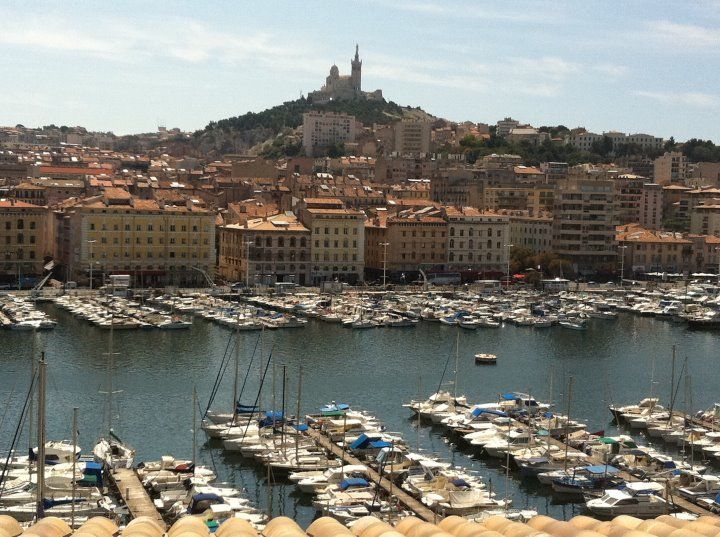
Today I start with a great conference which was held in Marseille this July. First, I have to thank the organizers, in particular Thierry Masson, for their very warm welcome. Thierry, who fell in love with Marseille (the photographs randomly appearing on the conference website are from his personal collection), shared his enthousiasm with all of us. He gave me a 1 meter long panoramic view of the Vieux Port which he assembled himself out of photographs taken in 1869. This gorgeous piece of work now stands in my office and helps me remember the wonderful moments spent drinking some wine while staring at the very same view, on which the sun set. Magical !

Frontiers of Fundamental Physics 14

On the more serious side, this very broad conference is one of those few where you can talk to people well outside your field, and hear from them about the hottest news out there.

For instance Carlo Rovelli told about a conjectural new state of matter : "Planck stars" ! To find what these objects are expected to be, here is a (rather critical) blog review, with a response from the author. The original paper is here.

But of course there was also more specialized sessions, with a very high density of interesting talks (at least in the mathematical physics sessions I attended. By the way the slides of my own talk are here. I let you judge for yourself whether it increased or decreased the density).

One thing that struck me was Fedele Lizzi's and collaborators result about bosons stopping their propagation at high energy in the spectral standard model. With Nadir Bizi, we have a result which says that an almost commutative manifold cannot have a noncommutative causal structure (which we define), unless the causal structure on the commutative part disappears at small scales. The methods are completely different but point in the same direction ! Maybe they simply both point to a breakdown of the theory at high energy scale : after all the smooth manifold structure on the spacetime part of the model cannot be trusted at arbitrarily high energy.

Walter van Suijlekom was there too (you can see his comments about the conference here). He has wonderful pedagogical talents. You can translate "I understood what the hell he was talking about !". I even found his discussion of inner perturbation in NCG very enlightening, which is no small feat since I'm a really slow learner. Given his great clarity of exposition, his new book promises to be one of the best entry point in the field.

Voir les commentaires

L'éléphant N° 7 et Hors-série

4 Juillet 2014, 22:03pm

| 

Publié par Fabien Besnard

Je prends enfin le temps de faire la publicité qu'il mérite au numéro 7 de L'éléphant, ainsi qu'au numéro Hors-série spécial jeux ! Ils sont tous deux en kiosque depuis une quinzaine de jours, mais vous pourrez les trouver tout l'été.


Pas d'article de votre serviteur dans ces numéros, mais je vous réserve une petite surprise pour le numéro 8, alors soyez patients...


L'éléphant N° 7 et Hors-série

Voir les commentaires

Navrant

23 Juin 2014, 22:02pm

| 

Publié par Fabien Besnard

Vendredi dernier je suis allé chercher mon fils à l'école.  Les grands sortent les premiers.  Ils sont tous habillés en bleu et ont les joues peintes en bleu-blanc-rouge. Le maître sort à son tour : il arbore un tee-shirt de l'équipe de France de football et un sourire satisfait. C'est apparemment lui le responsable de ce forfait. C'est à lui que je m'apprête à confier mon fils dans quelques années.

L'école est un lieu de vie, qu'ils disent. 

Voir les commentaires

Quadrature

24 Mai 2014, 11:22am

| 

Publié par Fabien Besnard

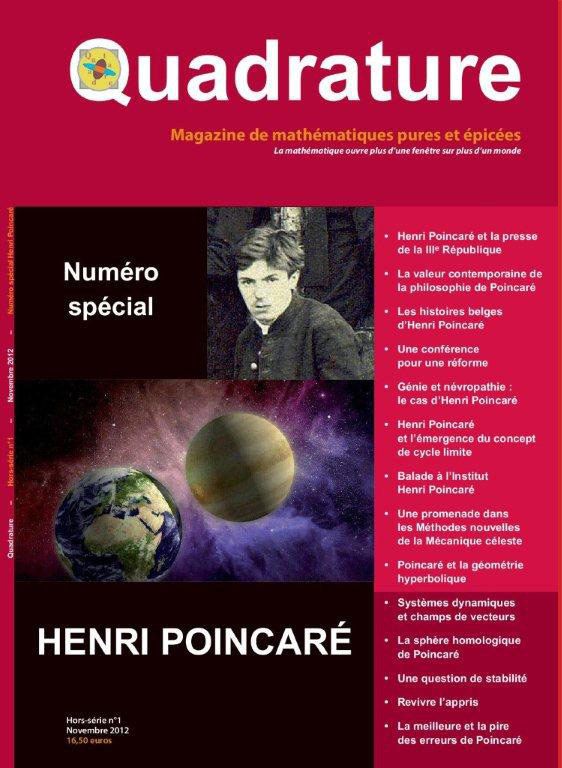
Le directeur de la revue Quadrature m'a demandé de bien vouloir mettre un extrait gratuit de son magazine sur mon blog. Je le fais bien volontiers, d'autant plus qu'ayant eu l'occasion de lire cette publication, je sais qu'elle est de très bonne qualité, et œuvre depuis 25 ans pour la diffusion de la culture mathématique.


Bonne lecture !

Quadrature

Voir les commentaires

Documentaire sur Lagrange

7 Avril 2014, 15:27pm

| 

Publié par Fabien Besnard

Un documentaire d'une trentaire de minutes sur le mathématicien et physicien Joseph-Louis Lagrange (1736-1813).

Voir les commentaires

Two exercises on convex cones in Banach spaces

12 Mars 2014, 21:57pm

| 

Publié par Fabien Besnard

I happened to work in a particular kind of finite dimensional algebras for quite a bit, and it's amazing how quickly you forget the subtleties which can occur in infnite dimensions. Now that I resumed a previous work that I had done, I came across an hypothesis that I put in a theorem, and it took me a while to (re-)understand why this hypothesis was not always satisfied. Here is the thing in the form of two exercises (so that if I forget it again, I can just take a look back here !). The second gives a solution to the first, so if you want to do it the hard way, do the first one first !


1) Find a closed convex cone C in a (real) Banach space V such that C-C is a strict subspace of V which is dense in V.


2) Let V be the Banach space of continuous functions on [0;1] with the uniform norm. Let I be the closed convex cone of non-decreasing elements of V.


a) Show that I-I is not V.

b) Show that I-I is dense in V.


You can show 2b by an abstract structural argument... or you can show the density inside a particular subspace of V that you already know to be dense in V.


Voir les commentaires

30 secondes de célébrité

21 Février 2014, 18:58pm

| 

Publié par Fabien Besnard

Une journaliste de M6 est venue me demander mon avis sur la crédibilité scientifique des frères Bogdanov (en un mot : nulle).

Bien que le reportage soit destiné à passer dans une émission qui n'est a priori pas ma tasse de thé ("must célébrité"), j'ai accepté de lui répondre car j'ai trouvé sa démarche sincère et honnête. Et puis il faut bien que quelqu'un s'y colle...

L'interview a duré une heure, mais elle m'a prévenu que ça avait été "très synthétisé". J'imagine donc qu'il en reste 30 secondes, mais si ça vous intéresse de voir ma bobine, ça doit passer demain à partir de 17h30.

Erratum : on vient de me prévenir que la diffusion était reportée au 1er mars. 


MAJ du 08/03 : la diffusion est à nouveau reportée à une date ultérieure. Je vous préviendrai dès que j'en saurai plus.

Voir les commentaires

Trois conseils à Vincent Peillon par Ali Devine

14 Février 2014, 21:48pm

| 

Publié par Fabien Besnard

Je relaye ici un excellent billet posté par Ali Devine sur son excellent blog (où il est prouvé une fois de plus que l'humour est le dernier refuge du désespoir).


Extrait :

"Ma première suggestion au ministre serait évidemment de revoir en profondeur sa réforme des rythmes. Dans une interview récente, le Ministre a présenté cette réforme comme le fait de « donner aux enfants une matinée supplémentaire pour apprendre à lire ». C’est jouer sur les mots, car le temps scolaire n’a pas changé d’un iota depuis la calamiteuse réforme Darcos.  C’est aussi occulter un fait essentiel : par rapport à ce qui se faisait il y a vingt ans, un élève de cours élémentaire consacre 100 heures de moins chaque année aux matières fondamentales (français, mathématiques, éveil, devoirs). Par rapport à un élève d’il y a cinquante ans, la différence est de 250 heures… Si l’on souhaite vraiment « donner plus de temps aux enfants pour apprendre », c’est donc le nombre d’heures de cours qu’il faut de toute évidence accroître, en revenant au minimum à une dotation de 26 heures par semaine et en allégeant les programmes de ce qui les encombre inutilement.

Dans les quatre journées et demie qu’ils passent désormais entre les murs de l’école, les élèves de CE2 (qui je le rappelle ont 8 ans) doivent en effet caser du français, des mathématiques, de l’anglais, des sciences expérimentales et/ou de la technologie, de l’histoire et/ou de la géographie et/ou de l’instruction civique et morale, des arts visuels et/ou de l’éducation musicale avec en bonus éventuel une des vingt heures annuelles d’histoire des arts enseignée de façon transversale, de l’éducation physique et sportive, des technologies de l’information et de la communication (elles aussi enseignées de façon transversale), neuf récréations de quinze minutes, des devoirs dans les différentes matières (si le maître juge utile d’en donner et trouve un créneau pour en faire), plus à présent des activités périscolaires qui dans certaines écoles varient d’un jour à l’autre. Je ne vois pas comment cet éclatement du temps passé dans l’école pourrait favoriser les apprentissages. Quant aux maîtres, ils sont confrontés à un dilemme : favoriser le français et les mathématiques en minorant ou en oubliant le reste (c’est ce que je ferais), ou bien pratiquer une sorte de dispersion ludique, en organisant leurs journées et leurs semaines comme des séances de zapping.

Il faut donc faire le ménage. Je pense en particulier à l’anglais, pardon, à la « langue étrangère ou régionale », qui ne donne lieu dans l’immense majorité des cas à aucun apprentissage réel et qui se voit pourtant offrir 54 heures par an. Et si on pouvait aussi soulager les maîtres du prêchi-prêcha sur les questions de genre ou le tri des déchets, ce ne serait pas plus mal."

Voir les commentaires

L'Éléphant N°5

17 Janvier 2014, 21:26pm

| 

Publié par Fabien Besnard

Je veux juste vous signaler avec un peu de retard la parution du N°5 de la revue l'Éléphant cette semaine.


Vous pourrez y trouver le 4e et dernier épisode du dossier "de quoi est fait le monde ?", dont vous pouvez lire le début ici.


PS : on m'a signalé que beaucoup de gens oubliaient de se réabonner. Hé oui, un an et 4 numéros, cela passe bien vite. Vous pouvez aussi commander les anciens numéros sur le site de la revue.

L'Éléphant N°5

Voir les commentaires

<< < 1 2 3 4 5 6 7 8 9 10 20 > >>